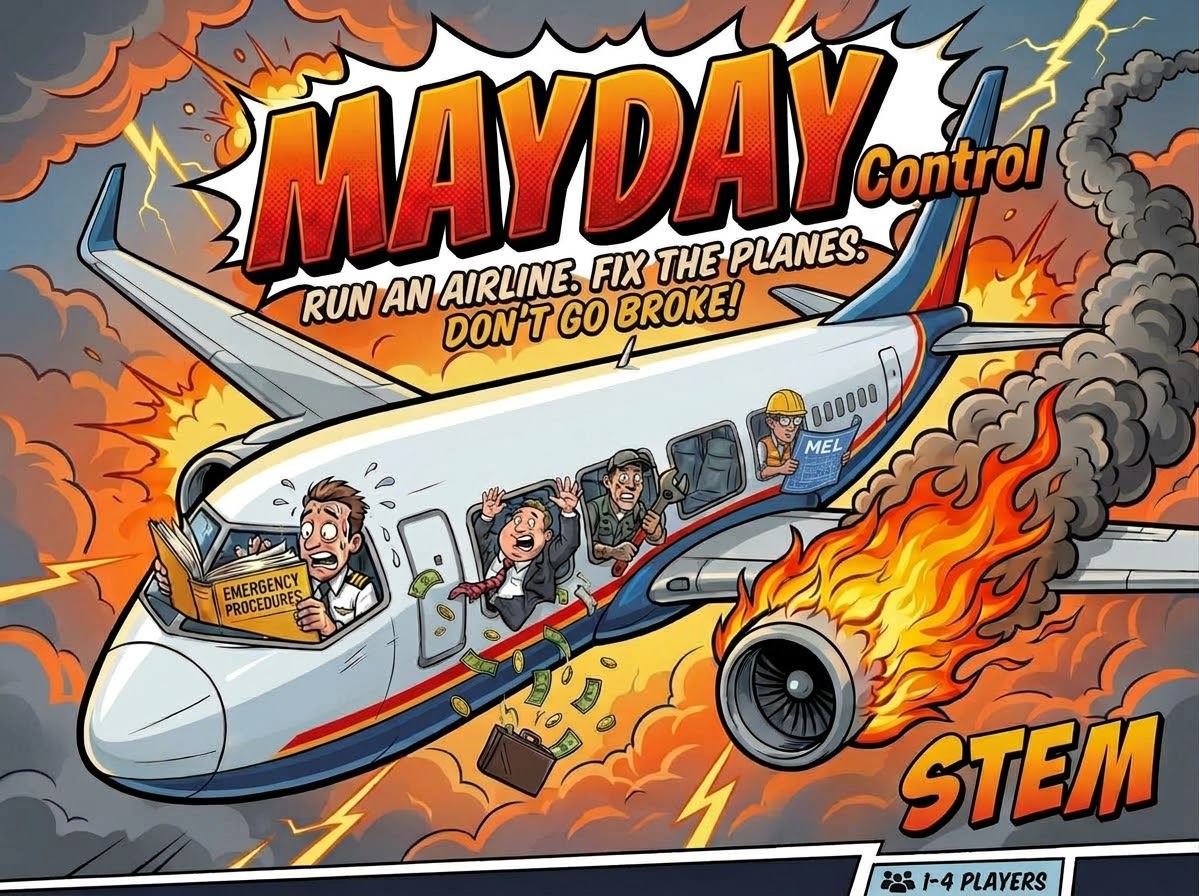
Why Mayday Control exists
Mayday Control isn't just a game — it's meant to put you in the seat of the people who actually run an airline. Every decision mirrors one made for real, every single day, across the industry: the CEO weighing expansion against risk, the COO keeping a fleet reliable without bleeding cash, maintenance engineers and dispatchers managing MELs and Airworthiness Directives under pressure, revenue managers watching what rivals are doing at a shared hub, and network planners deciding where a new route actually makes sense.
If you're thinking about a career in aviation, we hope this sparks real curiosity about the industry's complexity and the problem-solving it demands. If you already work in aviation, we hope it's a fun, honest reflection of just how many moving parts — literal and figurative — go into keeping an airline in the air.
Overview
2–4 players (human or AI) each run a competing airline on a shared global route map. Buy routes, grow your fleet, keep it flying, and out-compete the others to win.
Where to start
New to Mayday Control? Read The basics first, then the tab for the level you want to play. Each level has its wheel odds, worked scenarios and tips. You can open this guide at any time during a game with the ? button at the top.
Credits
The 3D globe is built with globe.gl by Vasco Asturiano, three-globe and three.js, all open source under the MIT License. Earth imagery: Blue Marble, courtesy of NASA. Full notices are in LICENSES.txt.
The goal
Run an airline better than your rivals. You win by reaching $9,000,000 in cash first, by Dominance (a connected network of 10+ hub-to-hub routes across 3+ continents, 3+ aircraft, the whole fleet airworthy, held for 3 turns in a row), or by being the last airline standing.
A turn in four steps
- Spend up to 2 actions: buy a route, an aircraft or a spare part, repair an open MEL, assign a route to an aircraft, or trade.
- Fly: pick an aircraft and press Fly. Flying costs no action. The event wheel decides how the flight goes.
- Read the result: revenue, fees and any MEL or AD card appear in the log.
- Your turn ends after the flight, so do your buying and repairs first. Press Fly all assigned aircraft to send your whole fleet at once, or End turn to pass without flying.
Prices at a glance
| Short route
up to 1,500 km | Medium route
up to 4,100 km | Long route |
|---|
| Buy the route | $15,000 | $50,000 | $100,000 |
| Most it can pay per flight | $20,000 | $80,000 | $200,000 |
An extra aircraft costs $400,000 and a spare part $50,000. A grounded aircraft costs $50,000 every turn. Repairing at an MRO station instead of using a part costs $30,000.
What the wheel can do
- White, clean flight: 100% of the route's pay.
- Green, MEL-C: 50% pay until you repair it.
- Yellow, MEL-B: 50% pay and same-continent routes only until repaired.
- Red, MEL-A: aircraft grounded, no pay, $50,000 every turn until repaired.
- Blue, thunderstorm: held at the airport for a turn, $50,000 fee.
- Black, AD: diverted to the nearest MRO station, $50,000 clearing fee, no pay.
Setting up
Every airline begins with $1,000,000 and a single widebody jet. On your first turn, click any city on the globe to set it as your home base.
Growing your fleet
A single aircraft can only earn so much. Buy additional aircraft, assign each one a route, and use "Fly all assigned aircraft" to send your whole fleet out in one click each turn rather than flying planes one at a time.
Building your network
There's no fixed set of routes — you design your airline's network. The map has about 46 major hubs (shown in capital letters on the globe and marked ★ in the city lists). Any two hubs can be linked, as long as they're within an aircraft's range of roughly 14,000 km. Every other city is a regional city: it can only be linked to a hub within about 1,500 km (or, for the most remote cities, to the nearest hub).
Distance sets a route's class — short (up to 1,500 km), medium (up to 4,100 km) or long — and with it the price to buy it and the most it can earn per flight. When you pick a destination, the list shows each option's distance and cost.
Hub feed
Real airlines work the same way, a model called hub-and-spoke: short regional flights carry passengers into a hub, where they connect onto long-haul flights. A long flight between two hubs is only as full as the passengers feeding it. A hub-to-hub flight earns 50% of its normal revenue if you have no regional routes at the hub it departs from, rising to 100% once you own 4 of them. Each direction is measured at its own departure hub, so a route needs feeders at both ends to be full both ways. The routes that count are short links from the hub to nearby regional cities, and they cost far less than the long flights they fill. Regional routes themselves aren't affected. The game points out an under-fed hub the first time it costs you money, shows each route's feed percentage when you assign an aircraft, and the lightbulb tip suggests the cheapest route to fix it.
Hub competition
Routes themselves stay exclusive — only one airline can own a given city pair. But if a rival operates any route touching one of your endpoints, your revenue there is diluted, compounding with each additional rival present. Buying into a city a leader depends on is a real way to slow them down, not just grow your own network.
Repairs & spare parts
A shared bank of 40 spare parts serves every airline in the game. Clear an open MEL for free with a part from your own inventory, or pay a cash fee at an MRO station instead. MRO stations are marked on the map and also where Airworthiness Directives force a diversion to.
Trading
Trade routes, aircraft, or spare parts directly with another player for an agreed cash price — useful for untangling a network or helping (or striking a deal with) a rival.
Bankruptcy
If your cash goes negative and you have no routes, aircraft, or parts left to sell off to cover it, your airline is eliminated.
Helpful tools
Tap the lightbulb icon any time for a contextual strategy tip based on your current situation. Click a route name (such as BOG-GRU) in the fleet table to see what share of that route's maximum revenue it is earning, why it falls short, and what to buy to earn more. The chart icon next to the gauges opens a window showing every airline's cash over time and where each is headed if its network stays as it is. Major events — lead changes, hot streaks, hub competition, Dominance progress — get an on-screen announcement with spoken audio, while AD diversions and under-fed hubs open a pop-up that waits for you, and the full event/flight log on the right tracks everything that's happened in the game.
Scenarios
The hub that isn't full. You own a long hub-to-hub route (max $200,000) but only 2 regional routes at the departure hub. Hub feed is 50% + 12.5% per regional route, so you are at 75%: a clean flight pays $150,000. Add two more cheap regional routes ($15,000 each) and the same flight pays $200,000.
A rival moves in. A rival buys a route touching one of your hub cities. Your pay there is multiplied by 75% for each rival present. Defend by owning more routes at that hub, or hit back by buying into the rival's key city.
Red wheel, no parts. Your only aircraft lands on MEL-A, 0 pay and $50,000 a turn. A spare part ($50,000) clears it for free; without one you pay $30,000 at an MRO station. Either way, the sooner the better: every turn grounded is another $50,000.
An AD diversion. An AD sends the aircraft to the nearest MRO station and the flight earns nothing. Make sure you own a route from there, or the aircraft is stranded until you buy one.
Tips for every level
- Build regional routes around your hubs before you buy long routes: they are cheap and they fill the long flights.
- Keep at least one spare part and a cash cushion of about $100,000 per aircraft.
- Add a second aircraft once your first earns reliably, then give each one its own route.
- Use the lightbulb for a tip about your exact situation and the chart icon to see where every airline is headed.
- Click a route name in the fleet table to see why it earns less than its maximum.
Easy: learn the game
The simple version: no STAR auctions and no fuel prices. Problems are rare and the AI airlines play cautiously, so you can concentrate on building a hub-and-spoke network. A built-out 4-aircraft network typically reaches the target in about 13 turns.
Scenario: your first five turns
Turn 1: pick a hub city as your home base. Turn 2: buy two or three short regional routes at that hub ($15,000 each) and a medium route out of it ($50,000). Turn 3 onward: fly the medium route. Clean flights come up about 8 times in 10 and pay $80,000 each, so you are in profit within a couple of turns. Next: a second hub, then a second aircraft.
A rare Red: on a 2% result the aircraft is grounded. Do not panic: use a spare part and carry on. With almost no repairs needed, one spare part is plenty.
Tips
- Expand fast. Cash sitting unused earns nothing and Easy punishes mistakes very lightly.
- Practise hub feed: four regional routes at a hub make your hub-to-hub flights pay 100%.
- Try for Dominance: with so few groundings it is the quickest route to a win.
- When you feel comfortable, move up to Medium for repairs, rivals and STAR auctions.
Medium: a real airline
A steady mix of repair bills, groundings and surprises, plus STAR deals. A built-out 4-aircraft network typically needs about 31 turns. No fuel prices.
How STAR auctions work
From round 3, an announcement may appear between rounds: a sponsorship or supplier contract. Every airline places a sealed bid (minimum $5,000, or pass). The highest bid wins, pays its bid and everyone sees the winning amount. A deal can be held up to 2 at a time.
- Co-brand credit card: +5% on every route, 10 turns. Safe and steady.
- Corporate exclusivity: +10% on hub-to-hub routes, 6 turns. Cancelled if an aircraft is grounded for 2 of your turns in a row.
- Belly cargo: +15% on long routes, 6 turns. A storm or AD on a long flight costs $25,000.
- Tour operator block-space: one extra regional route at every hub, 8 turns.
- Alliance: +15% on routes touching one named hub, 6 turns. Worthless if you don't fly there.
- Government mail: $30,000 at the start of each of your turns for 8 turns, if an aircraft is flying.
- PMA parts: spare parts cost $35,000 instead of $50,000 for 8 turns, but each fitted part has a 15% chance of failing.
Scenario: should you bid?
A co-brand credit card deal appears. Your routes earn about $100,000 per turn in a good stretch, so +5% is about $5,000 per turn, about $50,000 over 10 turns. Each deal card shows what it is worth to your airline and a break-even line for the bid you type. Bidding $20,000 leaves a profit of about $30,000; bidding $60,000 loses money. Expect rivals to bid around 35% of a deal's value, so bidding somewhere between 30% and 50% of the value is a sensible target. Deals grow in value as your fleet grows.
Hub standoff: an alliance deal names a hub where two airlines fly. It is worth more to both, so the bidding gets tense. Think about whether a bid is worth it if you lose the next one.
Tips
- Hold a reserve before bidding: a STAR bid you cannot afford leaves you short when a Red appears.
- Keep two spare parts. Groundings are common enough that waiting costs $50,000 a turn.
- Exclusivity is risky if your fleet is thin: one long grounding cancels it. Cargo is best when your network is mostly long routes.
- Government mail is the safest income: it pays whatever the wheel does.
Hard: only a sharp airline survives
Constant groundings, repair bills and storms, STAR auctions (the same ones as Medium, described below), and fuel prices. A built-out 4-aircraft network typically needs about 76 turns, and bankruptcies are common.
How STAR auctions work
From round 3, an announcement may appear between rounds: a sponsorship or supplier contract. Every airline places a sealed bid (minimum $5,000, or pass). The highest bid wins, pays its bid and everyone sees the winning amount. A deal can be held up to 2 at a time.
- Co-brand credit card: +5% on every route, 10 turns. Safe and steady.
- Corporate exclusivity: +10% on hub-to-hub routes, 6 turns. Cancelled if an aircraft is grounded for 2 of your turns in a row.
- Belly cargo: +15% on long routes, 6 turns. A storm or AD on a long flight costs $25,000.
- Tour operator block-space: one extra regional route at every hub, 8 turns.
- Alliance: +15% on routes touching one named hub, 6 turns. Worthless if you don't fly there.
- Government mail: $30,000 at the start of each of your turns for 8 turns, if an aircraft is flying.
- PMA parts: spare parts cost $35,000 instead of $50,000 for 8 turns, but each fitted part has a 15% chance of failing.
Hard example: bid or keep the cash? A belly cargo deal appears (+15% on long routes for 6 turns). Your long routes earn about $60,000 a turn, so it is worth roughly $54,000. Bidding $20,000 looks good, but on Hard a single Red result costs $50,000 a turn. If a bid would leave you with less than about $100,000 per aircraft, pass: a missed deal is cheaper than a bankruptcy. Remember the cargo catch too: a storm or AD on a long flight costs $25,000, and Hard has plenty of both.
How fuel works
- Fuel has a market price index (1.00 is normal, $5,000 a unit; one unit flies about 1,000 km). It moves every round and sometimes spikes or crashes. The ⛽ button at the top shows it.
- Every flight that actually flies burns fuel by distance. Grounded, stormed or AD flights burn none.
- Fares include a fuel recovery sized for a normal price. Fuel dearer than normal eats into profit; cheaper fuel adds to it.
- You are never grounded for lack of fuel: any shortfall is bought at the market price.
- Hedge (costs no action): fill your tank (15 units per aircraft) when fuel is cheap, or sign a fixed-price contract (12 units at today's price + 3% for 6 turns, up to 2 at a time).
Scenario: a 5,571 km clean flight
| Fuel index | Fuel cost | Fuel recovery in fare | Net from fuel |
|---|
| 0.70 (crash) | $19,500 | $42,600 | +$23,100 |
| 1.00 (normal) | $27,900 | $42,600 | +$14,700 |
| 1.40 (spike) | $39,000 | $42,600 | +$3,600 |
A half-revenue MEL flight earns only half the recovery but burns the same fuel, so those flights can lose money on fuel; that balances out with the clean flights over time. If you own a contract at $5,150 a unit, every unit costs $5,150 whatever the market does: you win when fuel spikes and lose a little when it crashes.
Hedge plan: the index falls to 0.75. You fill the tank with 15 units at $3,750 = $56,250. Later the index spikes to 1.40: your next 15 units cost you $3,750 each instead of $7,000, saving about $48,750.
Don't over-hedge: a contract's unused units settle against the market at expiry. If you sign at a high price and the market falls, you lose the difference on every unit you did not burn. Sign contracts when the index is at or below about 1.00, and only for fuel you will actually burn.
Tips
- Check the index every turn. Below about 0.90 is a buying chance; above 1.30 burn from your tank and contracts, not the market.
- Be choosy at STAR auctions: a deal only pays if you survive to collect it. Bid when you have cash to spare, not your last reserve.
- Keep cash: with fuel and groundings, a single bad turn can cost $50,000 or more.
- Keep two or three spare parts and avoid exclusivity unless your fleet is healthy.
- Short regional flights burn little fuel. Shifting some flying there steadies your profit when fuel spikes.
- Open the fuel desk to see your expense breakdown: the "hedging result" shows whether your buys beat the market.